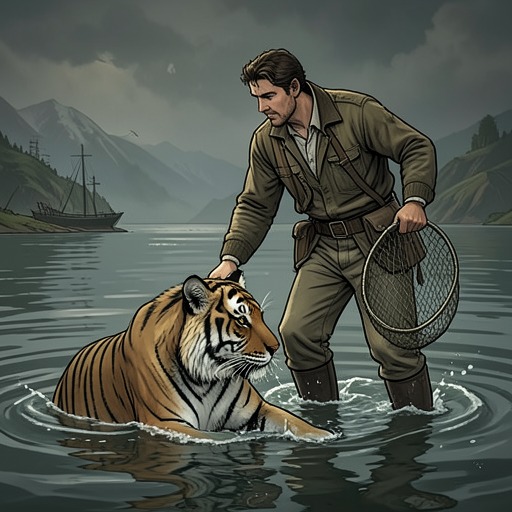
Pi Patel–Richard Parker relationship
Life of PiPi Patel and Richard Parker’s relationship is the unstable partnership at the center of Pi’s struggle to survive at sea: the tiger is at once an immediate danger, a creature Pi must manage, and a companion whose presence sustains his will to live. Their coexistence develops through territorial boundaries and repeated training, but never becomes simple trust. Its force is clearest in the ending: Richard Parker leaves without acknowledging Pi, and the uncompleted farewell remains a source of pain.
A Relationship Born of Necessity
After sleeping through the morning, Pi wakes to the reality that Richard Parker is aboard the lifeboat. He considers escape, but judges that swimming hundreds of miles toward land would mean certain death. Staying also carries mortal danger. With no safe alternative, Pi recognizes that survival depends on making a life alongside the tiger rather than imagining that either can simply leave the other behind.
At first, the bond is defined by fear. Pi imagines how quickly Richard Parker could attack, and the tiger’s growl intensifies his sense of danger. Pi’s decision not to give up does not make him unafraid; it gives him a reason to act despite fear. He begins constructing a raft from buoyant oars, life jackets, and a lifebuoy, trying to establish distance from the animal. The improvised barrier is an early expression of their relationship: Pi seeks separation, but even his attempt to remain apart depends on materials taken from the shared boat.
The encounter changes when Richard Parker makes a quiet, friendly-sounding call called prusten and rolls his head. Pi recognizes the sound from what he had learned about tigers, and the immediate threat recedes enough for him to think. He concludes that he must tame Richard Parker. In Pi’s view, the problem is no longer simply one of defeating the tiger or escaping him; both lives are bound to the same confined setting, and the likely course of time favors the animal’s physical resilience over Pi’s human weakness.
Territory, Training, and Uneasy Authority
Pi turns that recognition into a practical system. The Survival manual offers general advice about exposure, food, and navigation, but not about establishing dominance over a dangerous animal in a lifeboat. Pi therefore devises boundaries: Richard Parker’s territory is the floor and benches toward the stern, while the bow and the top of the tarpaulin are Pi’s, with the middle bench serving as a dividing zone. These limits make the boat legible as a contested space and give Pi a way to plan where he can shelter and work.
Training is an effort to make Richard Parker associate the whistle with seasickness and retreat. Pi’s method depends on the motion of the sea: he provokes the tiger, rocks the boat, and blows the whistle, then allows the animal to recover before repeating the exercise. The intended result is not affection but a reliable response to a signal. Once the association is established, Pi expects a whistle to deter trespassing without requiring another prolonged contest. Control, in this arrangement, is a behavior Pi must teach and reinforce, not a permanent state he can take for granted.
The lessons are dangerous and initially fail. Pi makes a shield from a turtle shell and advances toward the tiger, but Richard Parker’s charge knocks him into the water; Pi loses the shield and retreats to the raft. He tries again with a smaller shell. Across four encounters, Richard Parker strikes at him and Pi loses each shield. These repetitions teach Pi to attend to the tiger’s warning signals—his ears, eyes, whiskers, teeth, tail, and throat—and to back down before a charge becomes unavoidable. Pi then resumes the training from the lifeboat’s edge, using the boat’s movement and the whistle to make his own claim. His fifth shield lasts through the remainder of the training, marking progress earned through observation and persistence rather than the disappearance of danger.
Dependence and a Change in the Balance
The relationship shifts during a flying-fish catch. Richard Parker focuses on a large fish in Pi’s hands and appears ready to attack. Pi cannot retreat or use the whistle in time, so he holds the tiger’s gaze. After a brief contest, Richard Parker turns away. Pi gives him a portion of the fish, then begins spending more time aboard the lifeboat, moving first to the bow and later onto the tarpaulin. He remains afraid when circumstances warrant it, but the tiger’s mere presence no longer overwhelms him. The change is both practical and relational: Pi can occupy more of the shared space because he has learned the animal’s signals and established a measure of authority.
Pi also understands that authority rests partly on his ability to provide. Richard Parker had lived in a zoo, where food arrived without his having to hunt for it. At sea, Pi supplies food and fresh water, making his role visible in a setting without the jungle or river the tiger would otherwise depend on. Pi treats this provision as evidence of his influence: Richard Parker continues to leave him alive, including when Pi sleeps on the tarpaulin. Their arrangement thus involves more than the threat of punishment. The tiger’s reliance on resources Pi obtains helps sustain a precarious order, even though the evidence does not make that order equivalent to domestication or mutual understanding.
Pi’s dependence on Richard Parker is emotional as well as practical. He admits that part of him is glad the tiger is there. If Richard Parker died, Pi believes, he would be left alone with despair; the demands of living beside the animal keep him occupied and impel him to continue. Pi can hate the danger and feel gratitude for the same presence. He comes to see Richard Parker not merely as a burden to survive, but as a reason he has survived at all. This attachment does not cancel fear; it grows within the same conditions that make fear unavoidable.
Loss, Separation, and the Unfinished Farewell
When an oil tanker passes without rescuing them, Pi’s longing for rescue meets Richard Parker’s limited understanding of the event. The tiger watches the ship, then settles back down, registering its disturbance without recognizing that a chance at salvation has gone by. Pi responds by telling Richard Parker that he loves him and promising to get him to land. The declaration makes explicit how far the relationship has moved from its beginnings: Pi now imagines their survival as a shared undertaking, even though the tiger cannot answer in human terms.
The bond also has a terrible cost. During a later encounter with another castaway, Richard Parker kills the man after he crosses into the tiger’s space. Pi survives, but understands that Richard Parker has preserved his life at the expense of another. The episode makes their dependence morally complicated: the tiger is not simply Pi’s protector, and Pi’s gratitude does not erase the violence that accompanies his survival. The relationship can keep Pi alive while also exposing him to consequences he cannot control.
When they reach Mexico, Richard Parker leaps ashore and heads toward the jungle. He turns back neither to look at Pi nor to offer any concluding sign between them. Pi had expected some gesture that would make their separation intelligible; instead, Richard Parker disappears. Pi is left alone, grieving the tiger’s abrupt departure even as people come to rescue him. The goodbye he later imagines—one that would thank Richard Parker, acknowledge their survival, and wish him well—is not a conversation that took place. Its imagined form shows what the actual departure denied him: a chance to express gratitude and to give their shared ordeal a deliberate ending.
Significance of the Bond
The relationship develops through an unresolved contrast. Richard Parker is a threat Pi must restrain, but also a source of routine, purpose, and companionship. Training gives their coexistence structure without removing its danger; food and water give Pi leverage without making the tiger his equal. Pi’s understanding of the bond therefore rests on observed behavior and his own interpretation of what their survival means, rather than on any human-like response from Richard Parker.
The final separation reveals how much Pi has invested in that interpretation. Richard Parker’s failure to acknowledge him is painful precisely because Pi has understood their lives as joined, and because their practical dependence grew into lasting attachment for him. The relationship’s ending offers no reciprocal explanation or formal closure. Pi must carry both gratitude and grief, while the tiger returns to a world beyond Pi’s reach.